Peptide Half-Life Reference Guide
A practical guide to peptide half-life, why it differs from storage stability, and how to avoid mixing pharmacokinetics with vial-decay math.
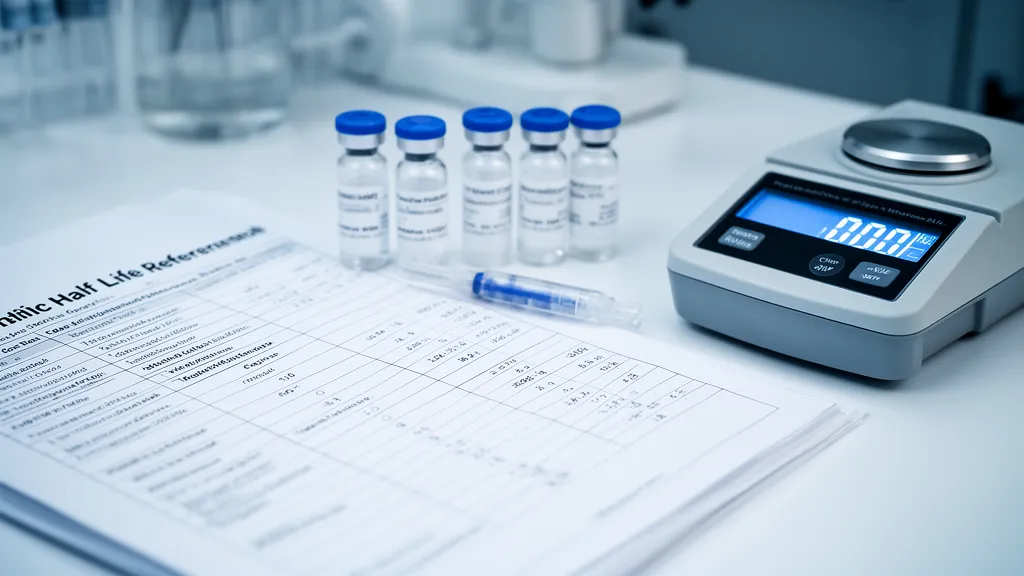
“Half-life” is one of the most overloaded terms in peptide discussions because people use it for two different ideas and then act as if they were interchangeable. One meaning is pharmacokinetic half-life, which describes how long the body takes to clear the molecule. The other meaning is storage stability, which describes how potency declines in the vial over time. Those are related only in the broad sense that both describe change. They do not answer the same question.
Why this distinction matters so much
Semaglutide and tirzepatide make the confusion obvious. Both are discussed as long-acting molecules in labeled or clinical contexts, which helps explain why dosing schedules can be weekly rather than daily. But that does not mean a reconstituted vial can sit for the same length of time without meaningful potency loss. Body clearance and vial degradation are running on different evidence chains.
When someone asks whether a vial can stay in the fridge another week, they are asking a storage question. When they ask why a product is dosed once weekly, they are asking a pharmacokinetic question. Mixing those two conversations leads people to borrow confidence from one area and spend it in another where it does not belong.
When pharmacokinetic half-life is the right concept
Use PK half-life to understand why a labeled dosing interval is daily, weekly, or somewhere in between, why accumulation behaves the way it does, and why missed-dose instructions are written the way they are. In that context, half-life is about what happens after the molecule is in the body.
When storage stability is the right concept
Use storage stability when the question is about refrigeration, room-temperature exposure, freeze risk, or discard timing for a vial that still looks visually normal. In that context, the relevant framework is not clinical dosing frequency. It is degradation chemistry, handling, formulation, and the evidence available for that specific preparation.
How PeptideClock keeps them separate
The half-life calculator can be useful for exploring decay mathematics, but even that tool depends on the assumptions you feed into it. The stability research cluster explains where those assumptions come from. For dose conversion and syringe math, the Peptide Calculator is the better tool because it handles concentration rather than pharmacokinetics.
The main editorial rule is simple: a long pharmacokinetic half-life should never be used as a shortcut argument for long reconstituted shelf life. Those are different claims and they require different support.
Related reading
- Reconstituted peptide shelf-life guide
- First-order decay explained
- Stability research cluster
- Dosing research cluster
References & evidence
- Ozempic FDA label — source for semaglutide product context.
- Mounjaro FDA label — source for tirzepatide product context.
- ICH Q1A(R2) — source for the stability-testing framework.