Use This Page For
Use this guide when you need the rationale behind fridge, freezer, and room-temperature handling rules instead of a short operational checklist.
This is the long-form storage reference for temperature control, workflow discipline, and the limits of shelf-life interpretation when peptide-specific data is thin. Use it when the short checklist is not enough.
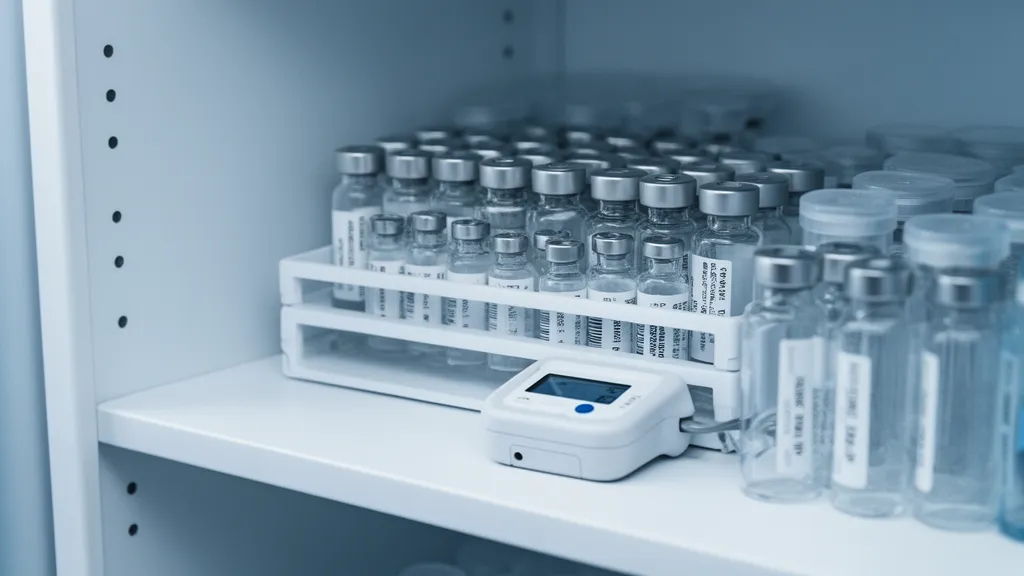
Use this guide when you need the rationale behind fridge, freezer, and room-temperature handling rules instead of a short operational checklist.
Storage failures usually do not announce themselves with one dramatic event. They accumulate through repeated warm exposure, weak labeling, inconsistent placement, and uncertainty about freeze tolerance.
The stability windows on this page include PeptideClock model estimates and should not be mistaken for label-backed guarantees unless the page cites a direct product label or study.
Operational reading: Use this guide when you need the rationale behind fridge, freezer, and room-temperature handling rules instead of a short operational checklist. Storage failures usually do not announce themselves with one dramatic event. They accumulate through repeated warm exposure, weak labeling, inconsistent placement, and uncertainty about freeze tolerance.
What should happen after this page: The right next step after reading a guide like this is usually to move into a narrower tool, chart, or peptide-specific page with the variables kept explicit. That keeps one guide-level rule from being stretched across a different vial size, solvent choice, route, or formulation than the page actually supports.
Common mistake to avoid: The most common failure mode is not arithmetic. It is transferring one clean-looking answer into a different setup without rechecking concentration, labeling, storage context, or the evidence tier behind the claim. The stability windows on this page include PeptideClock model estimates and should not be mistaken for label-backed guarantees unless the page cites a direct product label or study.
A guide should narrow the decision, not create fake certainty. When source-backed information ends, the responsible move is to label the gap, keep the assumption small, and avoid turning an estimate into a protocol.
In practice, the strongest use of a guide page is to filter out bad assumptions before you move to a narrower decision. That means checking whether the recommendation still applies once you swap peptide, dosage form, storage duration, or injection route. A good guide helps you ask the right follow-up question. It should not tempt you to skip that question.
Storage control is one of the strongest predictors of usable potency over time. This guide provides protocol-level handling standards you can apply immediately.
Good storage guidance has to separate three different things: regulatory stability principles, direct peptide-specific evidence, and cautious model estimates that help researchers plan when the literature is incomplete. Keeping those layers visible matters more than pretending every peptide has a clean shelf-life number behind it.
| Class | Fridge (2-8°C) | Room (~25°C) | Freezer (-20°C) |
|---|---|---|---|
| Robust | 30-60+ days | 7-14 days | Long-term powder storage preferred |
| Standard | 14-30 days | 3-7 days | Peptide-dependent |
| Fragile | 7-14 days | 1-3 days | High caution if reconstituted |
| Highly Volatile | 3-10 days | Often rapid decline | Strict peptide-specific control required |
Stability windows above are [Model Estimates — PeptideClock] based on peptide class decay rates calibrated to ICH Q1A(R2) principles. Individual peptide pages provide confidence levels. Label-backed window: Semaglutide 56 days after first use (Ozempic FDA label).
A dedicated cold space and a way to transport vials cover the two hardest parts of the checklist above — consistent refrigeration and avoiding thermal cycling. These are general cold-storage tools, not medical devices.
PeptideClock may earn a commission from qualifying purchases via links on this page, at no additional cost to you. Product links are general lab and handling equipment, not medical advice — See our disclaimer.
Thermoelectric · AC/DC/USB
A compact 4-liter thermoelectric fridge — a common way to keep reconstituted vials in a dedicated cold space away from a busy kitchen fridge. Runs on AC, 12V DC, and USB.
View on AmazonTravel / transport
A TSA-friendly insulated travel case with USB cooling plus a reusable biogel ice pack, for keeping temperature-sensitive vials cool on trips when a fridge is not available.
View on Amazon