Molecular Stability Clock
Visualize the degradation of reconstituted research compounds. Precision modeling for amino acid stability and potency tracking.
Stability Analysis
Decay Calculator
* Saline/Sterile Water applies a ~1.5× decay multiplier [Model Estimate — PeptideClock]. BAC water contains 0.9% benzyl alcohol (bacteriostatic preservative) per DailyMed.
Select a reconstitution date to calculate potency
Disclaimer: Mathematical estimate for research monitoring.
Formula: P(t) = 100 × (1−r)^t · First-order decay per ICH Q1A(R2) · Waterman & Adami 2005
The Science of Decay
Peptides are fragile amino acid chains held together by peptide bonds. Once reconstituted in Bacteriostatic Water or Saline, the countdown to molecular degradation begins via hydrolysis, oxidation, and deamidation.
Hydrolysis & Deamidation
Water molecules react with peptide bonds, leading to the primary cleavage of the molecular structure into inactive fragments.
Arrhenius Principle
The rate of chemical decay increases exponentially as storage temperature rises, drastically shortening the molecular half-life. (Waterman & Adami, 2005 — PMID 15778049 | ICH Q1A(R2))
Why Visualizing Potency Matters
In metabolic research and biohacking, using a compound that has dropped below 80% potency leads to inconsistent data, variable absorption rates, and unreliable outcomes. Our clock uses a first-order exponential decay formula calibrated against clinical stability data to estimate the point of diminishing returns.
How It Works
Enter Parameters
Select your peptide type and storage temperature
Set Time
Input days since reconstitution
Get Results
View current potency percentage
Frequently Asked Questions
How accurate is the peptide decay calculation?
Our calculator applies a first-order exponential decay model, with rate constants drawn from peer-reviewed stability studies for common peptides. The output is a PeptideClock model estimate, not a direct assay result: actual decay rates vary with the specific peptide formulation, pH, and storage conditions. Use it as a planning guide, and confirm critical decisions against product labeling or a stability assay.
What temperature should I store reconstituted peptides?
Refrigeration (2-8°C) is optimal for most peptides, maintaining over 95% potency after 30 days. Room temperature storage (20-25°C) results in approximately 27% potency loss over the same period for standard-class peptides. These figures are model estimates from the PeptideClock first-order decay calculator, not direct experimental assay data for all peptides. Label-backed exception: Semaglutide (Ozempic) maintains potency for 56 days at up to 30°C per FDA labeling.
How long can I use a reconstituted peptide vial?
It depends on the specific peptide and how it is stored — there is no single number that applies to all of them. As a PeptideClock model estimate, many standard-class peptides hold usable potency for roughly 30 days refrigerated, and some longer, but fragile peptides degrade faster and label-backed products like Semaglutide follow their own FDA-specified windows. Track your specific peptide with the calculator, and always check for visual signs of degradation such as cloudiness or discoloration before use.
Does reconstitution affect peptide stability?
Yes, reconstitution with bacteriostatic water begins the degradation process. The clock starts counting from the moment of reconstitution, not from the original lyophilized powder storage.
Explore More Tools
Comprehensive peptide management and dosing calculators
Multi-Vial Dashboard
Track multiple peptide vials simultaneously with real-time potency calculations
Explore Dashboard →Peptide Calculator
Calculate exact syringe units for your desired peptide dose with visual guide
Open Calculator →Peptide Database
Comprehensive research database with stability profiles for 51 peptides
Browse Database →Popular Peptides
View detailed stability data for the most researched peptides
Latest Research & Guides
Newest published posts first, pulled directly from the live archive.
Wound-Healing Peptide Research Watchlist: What Is Better Supported?
A source-checked watchlist of wound-healing peptides that separates better-supported candidates from names that still need stronger direct citation review.
Feb 16, 2026
Combining Peptides: Practical Stack Planning Guide
How to evaluate peptide combinations for compatibility, timing, and storage logistics with a research-first, risk-aware framework.
Feb 9, 2026
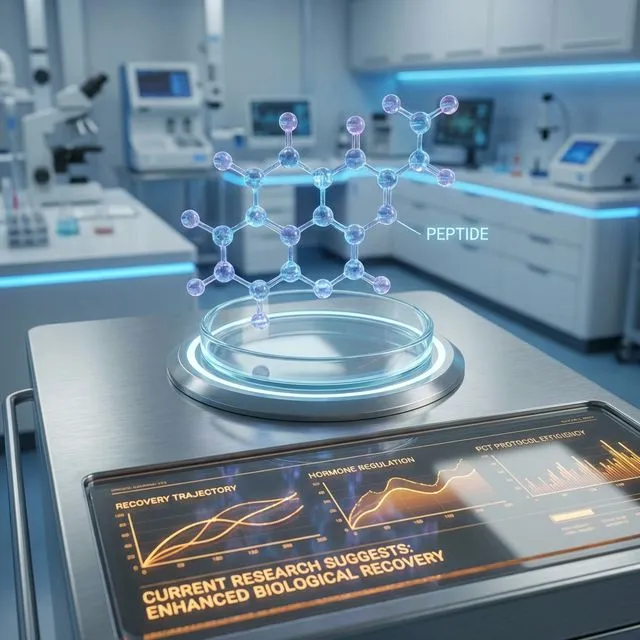
Peptide PCT Protocols: What Current Research Suggests
A research-first review of post-cycle recovery concepts, evidence limits, and risk-aware planning for peptide-focused protocols.
Feb 2, 2026