Use This Page For
Use this guide when you need the end-to-end reconstitution workflow, including solvent tradeoffs, sterile technique reminders, and concentration setup.
This is the site's full reconstitution workflow page: solvent choice, contamination controls, concentration planning, and the practical mistakes that cause clean math to fail in the real world.
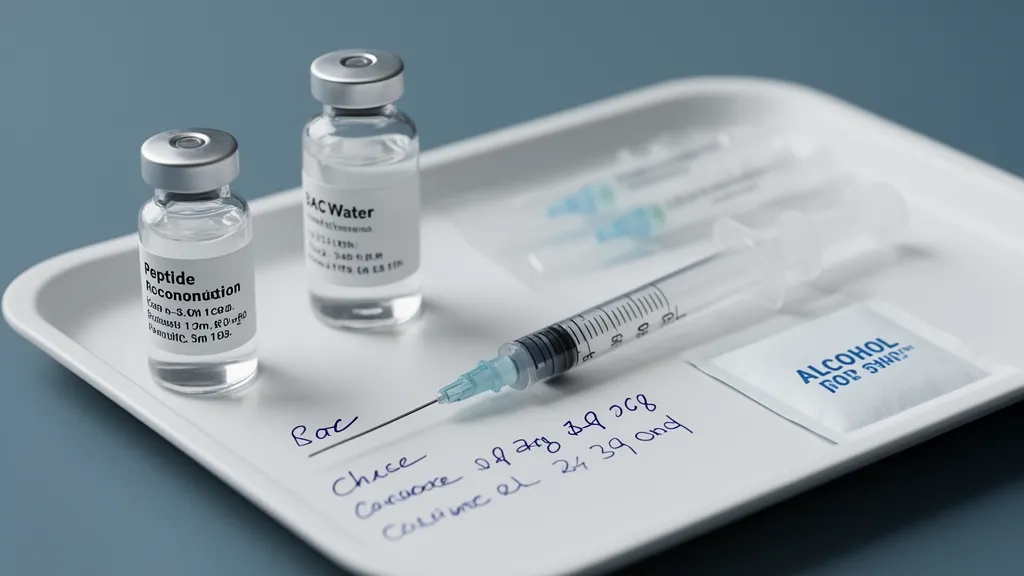
Use this guide when you need the end-to-end reconstitution workflow, including solvent tradeoffs, sterile technique reminders, and concentration setup.
A peptide can have perfectly correct math and still end up in a poor workflow if the vial is mixed harshly, labeled badly, or handled without basic contamination controls.
This guide combines public injection-safety guidance with cautious practical workflow rules. It should not be read as proof that one solvent or mixing method is optimal for every peptide.
Operational reading: Use this guide when you need the end-to-end reconstitution workflow, including solvent tradeoffs, sterile technique reminders, and concentration setup. A peptide can have perfectly correct math and still end up in a poor workflow if the vial is mixed harshly, labeled badly, or handled without basic contamination controls.
What should happen after this page: The right next step after reading a guide like this is usually to move into a narrower tool, chart, or peptide-specific page with the variables kept explicit. That keeps one guide-level rule from being stretched across a different vial size, solvent choice, route, or formulation than the page actually supports.
Common mistake to avoid: The most common failure mode is not arithmetic. It is transferring one clean-looking answer into a different setup without rechecking concentration, labeling, storage context, or the evidence tier behind the claim. This guide combines public injection-safety guidance with cautious practical workflow rules. It should not be read as proof that one solvent or mixing method is optimal for every peptide.
A guide should narrow the decision, not create fake certainty. When source-backed information ends, the responsible move is to label the gap, keep the assumption small, and avoid turning an estimate into a protocol.
In practice, the strongest use of a guide page is to filter out bad assumptions before you move to a narrower decision. That means checking whether the recommendation still applies once you swap peptide, dosage form, storage duration, or injection route. A good guide helps you ask the right follow-up question. It should not tempt you to skip that question.
Reconstitution quality controls both dosing accuracy and downstream stability. This guide outlines a clean, repeatable workflow.
Reconstitution is the point where several different failure modes overlap: incorrect concentration, poor sterility, unnecessary agitation, and vague labeling. A full guide helps keep those problems separate so one small workflow shortcut does not quietly undermine every later dose and storage assumption.
Source: DailyMed — Bacteriostatic Water for Injection (0.9% benzyl alcohol). CDC Injection Safety guidance.
Source: DailyMed — Sterile Water for Injection (no preservative, single-dose).
| Vial Amount | Volume Added | Concentration |
|---|---|---|
| 5mg | 2ml | 2.5mg/ml (2500mcg/ml) |
| 10mg | 2ml | 5.0mg/ml (5000mcg/ml) |
| 5mg | 5ml | 1.0mg/ml (1000mcg/ml) |
| 15mg | 3ml | 5.0mg/ml (5000mcg/ml) |
Alcohol pads to swab the stopper and a U-100 syringe to add solvent and draw doses. (Bacteriostatic water is a pharmacy item, not linked here.)
PeptideClock may earn a commission from qualifying purchases via links on this page, at no additional cost to you. Product links are general lab and handling equipment, not medical advice — See our disclaimer.
Swab before each draw
Individually wrapped sterile 70% isopropyl pads for wiping vial stoppers and the injection site before drawing. A cheap, high-use staple of clean reconstitution and dosing workflow.
View on Amazon1 mL · 100-unit
A 1 mL (100-unit) U-100 syringe with a 31G × 5/16″ (8mm) needle — the most versatile size, with the most range for larger draws. A long-standing favorite for general reconstituted-peptide measurement work.
View on Amazon