Use This Page For
Use this page when you want a printable reference table for common U-100 concentration examples and a quick explanation of the assumptions behind them.
This page is the broader print-friendly chart for common U-100 concentration examples. It helps users scan repeated syringe math quickly while keeping the calculator available for any custom setup.
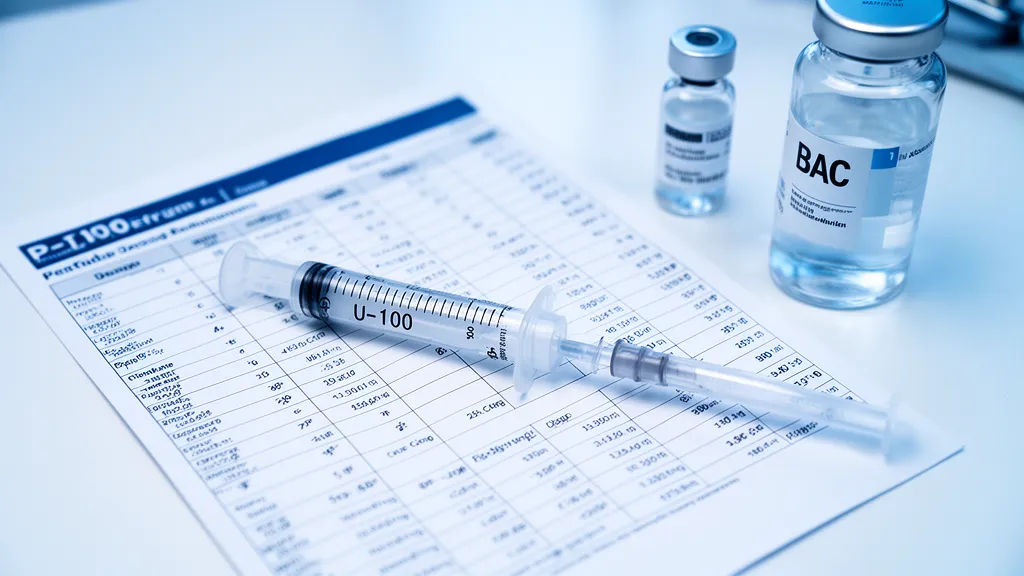
Use this page when you want a printable reference table for common U-100 concentration examples and a quick explanation of the assumptions behind them.
Static tables reduce repetitive arithmetic, but only when the reader respects the fact that a concentration change invalidates the row they were about to reuse.
This chart shows dilution math and syringe conversion logic. It does not recommend a peptide amount or establish that one visible example is the right setup for a specific compound.
Operational reading: Use this page when you want a printable reference table for common U-100 concentration examples and a quick explanation of the assumptions behind them. Static tables reduce repetitive arithmetic, but only when the reader respects the fact that a concentration change invalidates the row they were about to reuse.
What should happen after this page: The right next step after reading a guide like this is usually to move into a narrower tool, chart, or peptide-specific page with the variables kept explicit. That keeps one guide-level rule from being stretched across a different vial size, solvent choice, route, or formulation than the page actually supports.
Common mistake to avoid: The most common failure mode is not arithmetic. It is transferring one clean-looking answer into a different setup without rechecking concentration, labeling, storage context, or the evidence tier behind the claim. This chart shows dilution math and syringe conversion logic. It does not recommend a peptide amount or establish that one visible example is the right setup for a specific compound.
A guide should narrow the decision, not create fake certainty. When source-backed information ends, the responsible move is to label the gap, keep the assumption small, and avoid turning an estimate into a protocol.
In practice, the strongest use of a guide page is to filter out bad assumptions before you move to a narrower decision. That means checking whether the recommendation still applies once you swap peptide, dosage form, storage duration, or injection route. A good guide helps you ask the right follow-up question. It should not tempt you to skip that question.
This page is a print-friendly reference for U-100 insulin syringe math. It shows how common concentration examples map a target mcg or mg amount to syringe units, but it does not replace the full calculator for custom setups.
A single lookup row is fast, but it can hide the assumptions that make the row valid. This page exists so users can print the math, understand the U-100 baseline behind it, and still see the warnings that tell them when static tables stop being trustworthy.
Example calculation context only. The rows below show concentration math, not dosing recommendations. If your vial amount, diluent volume, or target amount differs from the chart, use the calculator for the exact numbers.
Each row starts with a vial amount and a reconstitution volume. Those two inputs determine concentration in mg/mL. From there, U-100 insulin syringe math stays constant: 1 mL equals 100 units, so each unit equals 0.01 mL. The last column shows how many units correspond to the example dose listed in that row.
| Setup | Vial | BAC Water | Concentration | Example Dose | U-100 Units |
|---|---|---|---|---|---|
| Low concentration reference | 5 mg | 5 mL | 1 mg/mL | 100 mcg | 10 units |
| Low concentration reference | 5 mg | 5 mL | 1 mg/mL | 200 mcg | 20 units |
| Low concentration reference | 5 mg | 5 mL | 1 mg/mL | 250 mcg | 25 units |
| Low concentration reference | 10 mg | 10 mL | 1 mg/mL | 500 mcg | 50 units |
| Low concentration reference | 15 mg | 15 mL | 1 mg/mL | 1 mg | 100 units |
| Common reference setup | 5 mg | 2.5 mL | 2 mg/mL | 100 mcg | 5 units |
| Common reference setup | 5 mg | 2.5 mL | 2 mg/mL | 200 mcg | 10 units |
| Common reference setup | 5 mg | 2.5 mL | 2 mg/mL | 250 mcg | 12.5 units |
| Common reference setup | 10 mg | 5 mL | 2 mg/mL | 500 mcg | 25 units |
| Common reference setup | 20 mg | 10 mL | 2 mg/mL | 1 mg | 50 units |
| Calculator baseline | 5 mg | 2 mL | 2.5 mg/mL | 100 mcg | 4 units |
| Calculator baseline | 5 mg | 2 mL | 2.5 mg/mL | 200 mcg | 8 units |
| Calculator baseline | 5 mg | 2 mL | 2.5 mg/mL | 250 mcg | 10 units |
| Calculator baseline | 5 mg | 2 mL | 2.5 mg/mL | 500 mcg | 20 units |
| Calculator baseline | 10 mg | 4 mL | 2.5 mg/mL | 1 mg | 40 units |
| Medium concentration | 10 mg | 3 mL | 3.33 mg/mL | 100 mcg | 3 units |
| Medium concentration | 10 mg | 3 mL | 3.33 mg/mL | 200 mcg | 6 units |
| Medium concentration | 10 mg | 3 mL | 3.33 mg/mL | 250 mcg | 7.5 units |
| Medium concentration | 10 mg | 3 mL | 3.33 mg/mL | 500 mcg | 15 units |
| Medium concentration | 15 mg | 4.5 mL | 3.33 mg/mL | 1 mg | 30 units |
| High concentration | 10 mg | 2 mL | 5 mg/mL | 100 mcg | 2 units |
| High concentration | 10 mg | 2 mL | 5 mg/mL | 200 mcg | 4 units |
| High concentration | 10 mg | 2 mL | 5 mg/mL | 250 mcg | 5 units |
| High concentration | 10 mg | 2 mL | 5 mg/mL | 500 mcg | 10 units |
| High concentration | 20 mg | 4 mL | 5 mg/mL | 1 mg | 20 units |
| Very high concentration | 15 mg | 2 mL | 7.5 mg/mL | 100 mcg | 1.3 units |
| Very high concentration | 15 mg | 2 mL | 7.5 mg/mL | 200 mcg | 2.7 units |
| Very high concentration | 15 mg | 2 mL | 7.5 mg/mL | 250 mcg | 3.3 units |
| Very high concentration | 15 mg | 2 mL | 7.5 mg/mL | 500 mcg | 6.7 units |
| Very high concentration | 20 mg | 2.67 mL | 7.5 mg/mL | 1 mg | 13.3 units |
| Dense concentration | 20 mg | 2 mL | 10 mg/mL | 100 mcg | 1 unit |
| Dense concentration | 20 mg | 2 mL | 10 mg/mL | 200 mcg | 2 units |
| Dense concentration | 20 mg | 2 mL | 10 mg/mL | 250 mcg | 2.5 units |
| Dense concentration | 20 mg | 2 mL | 10 mg/mL | 500 mcg | 5 units |
| Dense concentration | 20 mg | 2 mL | 10 mg/mL | 1 mg | 10 units |
The table assumes a U-100 insulin syringe. That standard means 100 units per mL regardless of whether the syringe body is labeled 30 units, 50 units, or 100 units. Smaller syringe sizes only change total capacity and practical readability, not the volume represented by one unit.
BAC water handling and multi-dose vial technique should still follow official labeling and injection-safety guidance rather than shortcut rules from online forums.
Use the full calculator when you need exact math for a custom vial size, a different reconstitution volume, a dose smaller than 2 units, or a dose that would overfill your selected syringe. It is also the better option if you want to check reverse conversions such as units back to mcg or mg.
If none of the rows above match your vial, the dosing chart generator builds a printable U-100 table from your own vial amount, reconstitution volume, and target amounts — the same chart as this page, for your setup instead of a common one.
For a deeper page on one specific amount — every concentration, reconstitution recipes, and the syringe size that reads most cleanly — open a dedicated conversion page. To understand the reasoning behind the math, see Peptide Dosing Explained, or browse the full mcg-to-units hub.
This chart covers common concentration examples only. Open the calculator for a single exact dose, or generate a printable chart for your own vial.
These answers clarify the concentration and syringe-math assumptions used in the visible table above.
No. This page is a print-friendly reference table for common concentration examples. Use the full calculator when your vial amount, reconstitution volume, or target dose does not match one of the rows shown here.
Because syringe units depend on concentration. A 250 mcg target at 1 mg/mL takes 25 units, while the same 250 mcg target at 5 mg/mL takes 5 units.
No. Each row is an example calculation context only. The table shows dilution math on a U-100 insulin syringe and does not provide prescribing guidance or protocol advice.
No. On U-100 insulin syringes, 1 mL always equals 100 units. Smaller syringe bodies change total capacity and readability, not the volume represented by each unit.
They overlap. A reconstitution chart focuses on the vial amount and water volume that set your concentration; a syringe dosing chart carries that concentration one step further into the U-100 units you draw. This page combines both: each row shows the vial, the reconstitution volume, the resulting concentration, and the units for an example dose.
Multiply your concentration in mg/mL by the units drawn, then by 10. For example, at 2.5 mg/mL, 10 units is 2.5 × 10 × 10 = 250 mcg. The full calculator handles reverse conversions and any concentration not shown in the table.
A U-100 syringe to draw the units in the chart, plus alcohol pads to swab the vial.
PeptideClock may earn a commission from qualifying purchases via links on this page, at no additional cost to you. Product links are general lab and handling equipment, not medical advice — See our disclaimer.
1 mL · 100-unit
A 1 mL (100-unit) U-100 syringe with a 31G × 5/16″ (8mm) needle — the most versatile size, with the most range for larger draws. A long-standing favorite for general reconstituted-peptide measurement work.
View on AmazonSwab before each draw
Individually wrapped sterile 70% isopropyl pads for wiping vial stoppers and the injection site before drawing. A cheap, high-use staple of clean reconstitution and dosing workflow.
View on Amazon