First-Order Decay Explained for Peptides
Why PeptideClock uses first-order decay logic, what that means in practice, and where the model should be treated as an estimate rather than a measured assay.
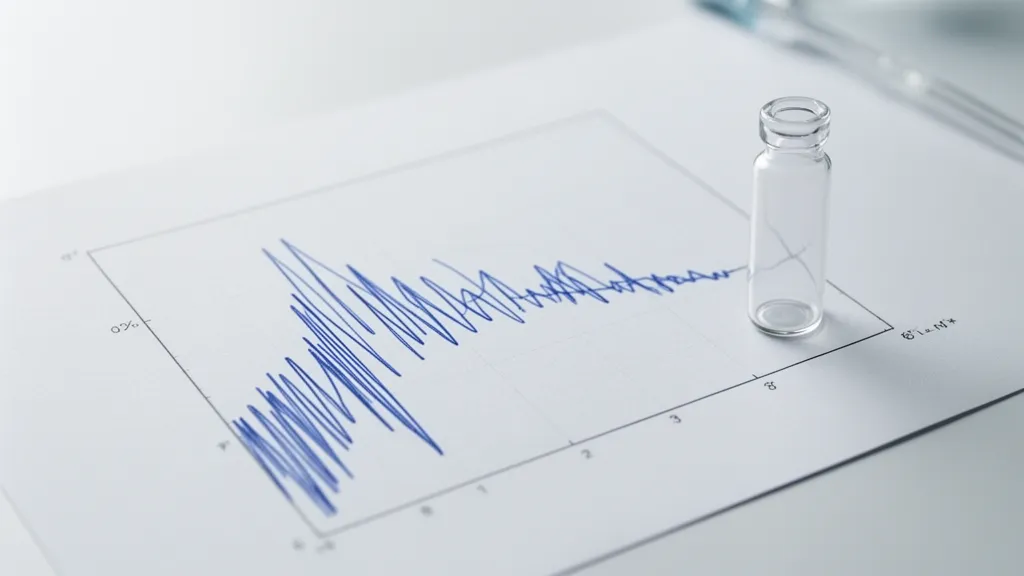
PeptideClock models potency loss with a first-order approach because it is a useful way to represent degradation when the amount lost depends on how much intact material is still left. In plain language, that means the vial loses a percentage of what remains, not the same absolute amount every day.
That distinction is easy to miss, but it explains why storage curves do not behave like a straight countdown. Early in the storage window, there is more intact material available to degrade, so the absolute amount lost per day can be larger. Later in the same storage window, the percentage rate may be unchanged while the absolute daily loss is smaller. The curve bends because the base keeps shrinking.
Why PeptideClock uses this model
First-order logic is useful because many chemical degradation processes are better described by proportional change than by a fixed daily subtraction. It gives the site a consistent way to compare storage scenarios, estimate remaining potency over time, and show why temperature shifts matter without pretending that every peptide shares the same direct assay data.
That last point matters. A model can be useful even when the evidence behind individual rates is uneven, but only if the site is honest about where the confidence is stronger and where it is still a conservative approximation.
Why the model is still not the same as measured assay data
For some peptides in the repo, evidence is stronger and the calibration is tighter. For many others, the daily rate is still a conservative [Model Estimate — PeptideClock] anchored to general stability science plus whatever peptide-specific evidence exists. That means first-order decay is best understood as a planning framework, not as a laboratory assay masquerading as one.
This is also why PeptideClock avoids treating the model as a universal law. Some degradation behavior can drift away from simple first-order assumptions, especially when aggregation, formulation effects, or non-linear stress responses become more important. The model remains valuable, but it should be used with the same evidence discipline as the rest of the site.
When this model is most useful
Use first-order logic when the question is about remaining potency over time, the impact of temperature changes, or why the beginning and end of a storage window do not lose the same absolute amount. If you want the actual calculations rendered automatically, the potency calculator and the half-life calculator are the right tools. If you want the policy and assumption layer behind the math, the stability research cluster explains where the model comes from and where it should be treated cautiously.
Related reading
References & evidence
- ICH Q1A(R2) — source for baseline stability-testing framework.
- Waterman and Adami — source for accelerated-aging and degradation modeling context.
- Wang and Roberts — source for non-linear aggregation caveats that limit blind extrapolation.