Subcutaneous vs Intramuscular Peptide Injection
A route-awareness guide explaining why subcutaneous and intramuscular peptide use should not be treated as interchangeable without protocol support.
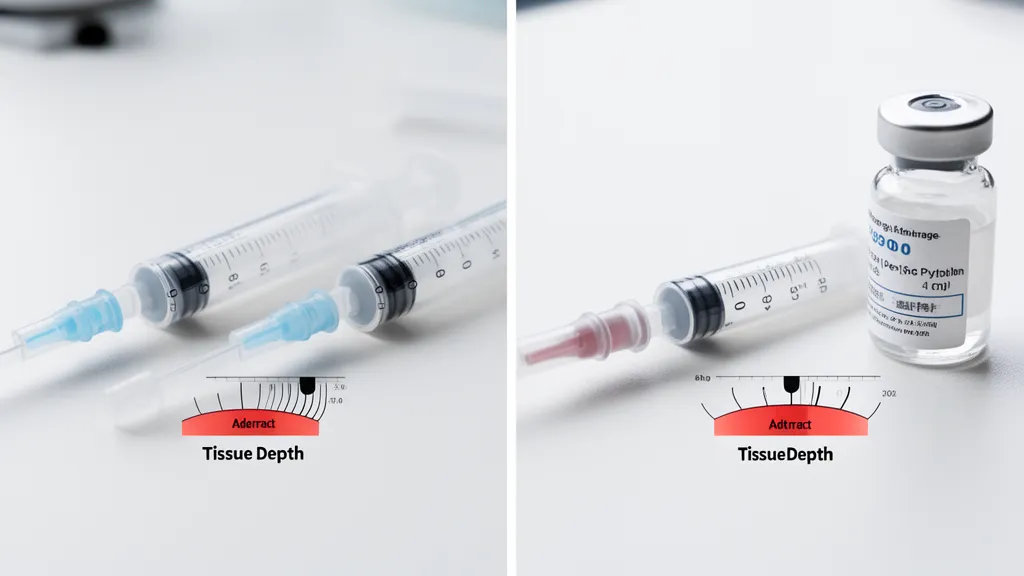
Educational context only. This explains how these compounds are described in approved product labels and research literature — it is not medical advice, an administration instruction, or a recommendation to use any substance. See the disclaimer.
Subcutaneous and intramuscular administration are not interchangeable instructions, even when the same peptide name appears in both conversations. That sounds obvious on paper, yet route changes are often treated casually in peptide discussions because people assume the concentration math is the only part that matters.
It is not. A route change affects which tissue receives the compound first, how the injection is placed, and which evidence actually applies to the workflow. That does not automatically mean one route is always better. It means the evidence supporting one route should stay attached to that route instead of being copied across contexts without support.
Why route discipline matters
Many questions on PeptideClock revolve around GLP-1 products and related research comparisons. Those examples frequently use subcutaneous administration in the approved product-label evidence, which is why subcutaneous route language appears so often throughout dosing and reconstitution discussions. The repetition is not an editorial quirk. It reflects where the strongest route-specific evidence exists.
This is also why route changes should not be justified only by convenience. One route may be discussed in preference to another for practical reasons, but that preference does not automatically carry the underlying evidence with it. When the route changes, the context of the instruction changes too.
Where the calculator fits and where it does not
The Peptide Calculator still matters because concentration math is route-agnostic. The same solution can be converted into units regardless of whether the discussion is subcutaneous or intramuscular. But the calculator only solves the math. It does not decide route, and it does not validate a route change. That is why route guidance and dosing math need to stay conceptually separate.
For the more practical subcutaneous side of the discussion, Peptide injection sites: subcutaneous guide covers site rotation and handling basics. If the question is broader evidence context, the Dosing research cluster is the better place to keep route-specific claims in proportion.
Related reading
- Peptide injection sites: subcutaneous guide
- Reconstitution FAQ
- Dosing research cluster
- U-100 syringe reference
References & evidence
- Ozempic FDA label — source for route-specific semaglutide administration language.
- Mounjaro FDA label — source for route-specific tirzepatide administration language.
- CDC injection safety guidance — source for sterile injection practices.