U-100 Insulin Syringe Reference
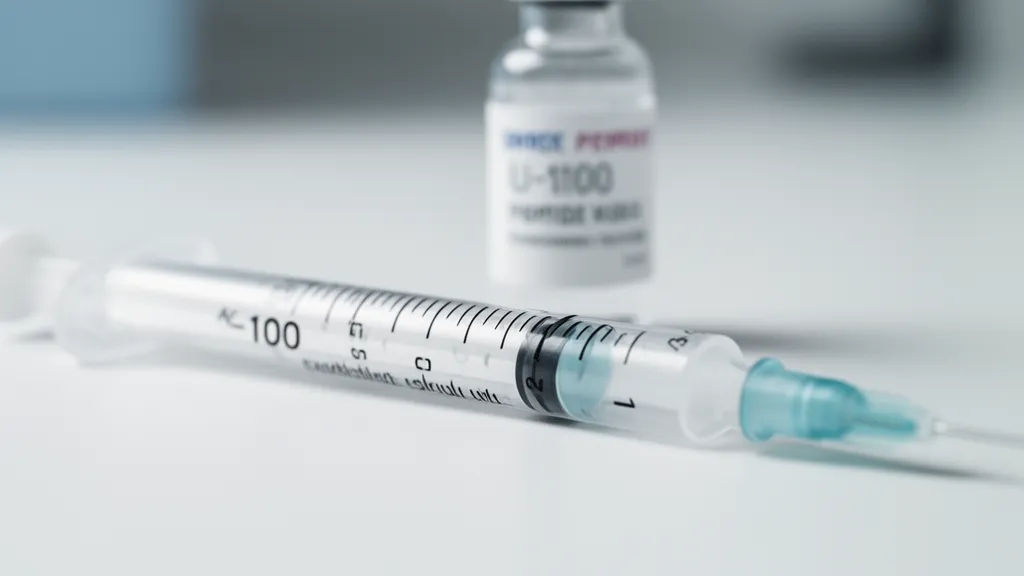
This page is the device standard behind most of the site's peptide math. One unit always equals 0.01 mL on a U-100 syringe; concentration determines how much peptide sits inside that volume.
- Use this reference to understand syringe units before converting any peptide amount.
- Smaller syringe bodies improve readability without changing the underlying U-100 standard.
- When a target amount lands on an unreadable mark, the concentration usually needs redesign rather than guesswork.
Use This Page For
Use this page when you need to translate between units and mL, compare syringe capacities, or check whether a planned draw will be realistically readable.
Why It Matters
A perfectly correct calculation can still produce a poor workflow if the target mark is too small or too crowded to draw consistently. This page helps catch that problem before use.
Evidence Boundary
This reference explains the U-100 hardware standard itself. It does not recommend a peptide amount or suggest that one syringe mark is clinically appropriate for a given compound.
How To Read And Use This Guide
Operational reading: Use this page when you need to translate between units and mL, compare syringe capacities, or check whether a planned draw will be realistically readable. A perfectly correct calculation can still produce a poor workflow if the target mark is too small or too crowded to draw consistently. This page helps catch that problem before use.
What should happen after this page: The right next step after reading a guide like this is usually to move into a narrower tool, chart, or peptide-specific page with the variables kept explicit. That keeps one guide-level rule from being stretched across a different vial size, solvent choice, route, or formulation than the page actually supports.
Common mistake to avoid: The most common failure mode is not arithmetic. It is transferring one clean-looking answer into a different setup without rechecking concentration, labeling, storage context, or the evidence tier behind the claim. This reference explains the U-100 hardware standard itself. It does not recommend a peptide amount or suggest that one syringe mark is clinically appropriate for a given compound.
- Keep concentration math, storage interpretation, and route-specific handling as separate decisions rather than one blended shortcut.
- Check whether the page is speaking about a labeled product, a research vial, or a generalized workflow before copying a number or rule.
- Use calculator and chart pages to compute, and use guide pages to decide whether the computation still matches the evidence context.
Where This Guide Stops
A guide should narrow the decision, not create fake certainty. When source-backed information ends, the responsible move is to label the gap, keep the assumption small, and avoid turning an estimate into a protocol.
In practice, the strongest use of a guide page is to filter out bad assumptions before you move to a narrower decision. That means checking whether the recommendation still applies once you swap peptide, dosage form, storage duration, or injection route. A good guide helps you ask the right follow-up question. It should not tempt you to skip that question.
Practical Review Checklist
- Identify whether the page is discussing a manufacturer-labeled product, a reconstituted research vial, or a general handling workflow.
- Confirm the variables that actually control the decision on your bench: concentration, solvent, route, vial size, storage temperature, and timing.
- Treat charts and examples as translation aids, then re-run the numbers in the calculator or reference page that matches the exact setup.
- If a claim sounds universal, look for the evidence tier behind it before carrying it into a different peptide or formulation.
What This Page Solves
Use this guide to answer a narrow but important question: what does a syringe mark actually mean in volume terms before any peptide-specific math enters the picture? Once that base is fixed, the calculator and chart pages can translate concentration into readable unit marks far more safely.
| Syringe mark | Volume | Why it matters |
|---|---|---|
| 1 unit | 0.01 mL | Smallest standard U-100 increment. |
| 5 units | 0.05 mL | Useful lower-bound readability target for many micro-dose workflows. |
| 10 units | 0.10 mL | Common clean-reference mark for quick conversion checks. |
| 25 units | 0.25 mL | Quarter-mL point on a U-100 scale. |
| 50 units | 0.50 mL | Half-mL point on a 50-unit or 100-unit syringe. |
| 100 units | 1.00 mL | Full milliliter on the U-100 standard. |
Quick rules
- One unit is always 0.01 mL on a U-100 syringe.
- Smaller syringes improve readability but do not change the unit standard.
- If your target amount lands below about 2 units, it is often worth rechecking concentration for readability.
- If your target amount exceeds syringe capacity, fix concentration or syringe size before drawing.
Use with the calculator
This page explains the hardware standard. The canonical calculator is what converts that standard into peptide-specific unit marks after concentration is known.
Evidence basis
- FDA insulin syringe standard confirms the fixed U-100 system of 100 units per mL.
- CDC injection safety guidance supports sterile handling and repeated-access vial caution.