Visual Inspection Guide: When to Discard Reconstituted Peptides
Learn to identify signs of peptide degradation through visual inspection. Comprehensive guide with photos descriptions and safety guidelines.
Key Takeaways
- Visual inspection can catch obvious red flags, but it cannot prove sterility, identity, or full potency.
- Persistent cloudiness, particles, color change, or container damage are conservative discard signals.
- Use the calculator tools for concentration math and time-based planning, not as a substitute for discard decisions.
Knowing when to discard a reconstituted peptide vial can reduce contamination risk, help protect data quality, and prevent avoidable handling mistakes. This guide focuses on what visual inspection can and cannot tell you.
Appearance versus the calendar: An unexpected appearance change deserves more weight than a reassuring calendar estimate. A clear vial can still fall outside a conservative time window, while a changed appearance is a separate signal that a calculator cannot resolve. Visual appearance cannot establish identity, potency, sterility, or safety; treat it as an observation that may require a conservative discard decision, not as an authentication test. (PeptideClock editorial standards)
Why Visual Inspection Matters
Even with careful storage, peptides eventually degrade, and contamination risk never disappears just because the vial has been refrigerated. The Potency Calculator tracks modeled chemical decay, but visual inspection catches a different class of problems: contamination, precipitation, aggregation, oxidation-associated changes, and simple container failure.
The useful rule is still conservative. Visual inspection cannot prove sterility or full potency, but it can reveal enough obvious trouble that using the vial stops being a rational gamble.
The 5-Second Visual Check
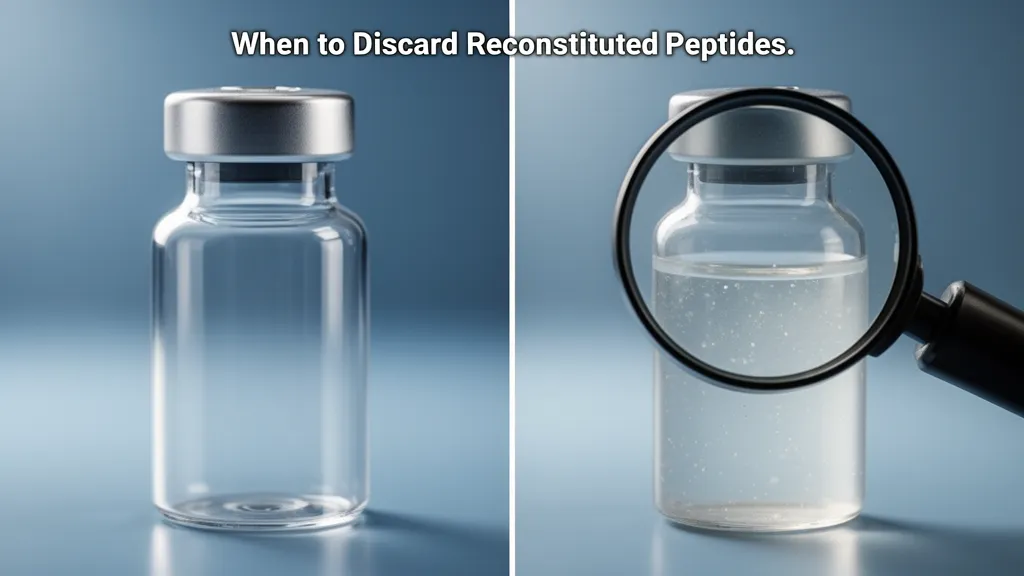
Before every dose, run the same short check. Look for clarity, color, particles, and any container damage that changes how much confidence the vial deserves.
✅ SAFE - Clear and Clean
The best-case appearance is still boring: crystal-clear solution, expected color, no visible floating matter, and no strange change in consistency. That appearance does not prove perfect potency, but it does mean the vial has not yet failed the most obvious visual screen.
⚠️ WARNING - Investigate Further
Not every warning sign means instant failure, but some do require a pause instead of automatic use. Slight cloudiness after temperature change or recent agitation may clear after brief rest. Tiny bubbles and a little foam after handling can also settle. The key is not to turn those temporary effects into permission to ignore a persistent appearance change. If the cloudiness or abnormal look remains after the vial settles, the safer interpretation is still discard.
❌ DISCARD IMMEDIATELY
Some changes should end the discussion immediately. Milky turbidity, floating particles, meaningful color change, thickened or gel-like consistency, and visible crystals all belong in the discard category because they represent a clear break from acceptable appearance. The exact underlying mechanism may vary, but the practical outcome is the same: the vial is no longer trustworthy enough to keep using.
Peptide-Specific Visual Characteristics
Most peptides on the site should look clear and colorless when handled properly. For compounds such as BPC-157, CJC-1295, ipamorelin, and many GHRPs, persistent cloudiness should be treated as abnormal rather than tolerated.
Some peptides have their own expected visual baseline. GHK-Cu commonly carries a pale blue tint because of copper chelation, while Melanotan II may show a slight yellow tint. The relevant question is not whether the solution is perfectly colorless. It is whether the appearance has changed away from its expected baseline or has started changing over time.
GLP-1 analogs such as semaglutide and tirzepatide should still look clear and colorless, although a slight increase in viscosity can be normal. What matters more is that these compounds can show visible aggregation after mishandling, temperature stress, or freezing, so white clouds, strings, or gel-like changes deserve immediate skepticism.
Container Compromise Checks
The container matters as much as the liquid. A compromised stopper, broken seal, damaged glass, or even a vial that can no longer be confidently identified all lower trust in the sample. The liquid may still look usable, but the storage chain has already become less reliable.
Storage-Related Visual Issues
After refrigeration, a vial may simply need a few minutes to settle and warm enough for a fair visual read. Condensation on the outside is not a problem. Persistent cloudiness, layer separation, or crystals that do not clear at room temperature are different and should be treated as real warnings.
After accidental freezing, cloudiness, particles, and visible volume or structure change are observations that warrant a pause rather than a potency verdict. Freezing-associated pH shifts have been linked with protein aggregation in specified protein/buffer systems (Thorat et al., PMID 32335158); that study does not establish the outcome for every peptide vial. For label-backed freeze-sensitive compounds such as semaglutide and tirzepatide, apply the named product’s label rather than generalizing from this page to research formulations.
Contamination Warning Signs
Bacterial contamination often announces itself through cloudiness that develops over time, new sediment, or an appearance shift that did not exist at the start. Fungal contamination is rarer, but any visible growth or film should end the discussion immediately. In either case, the correct next step is discard plus a review of technique, not a debate over whether the vial can be salvaged.
The Smell Test (Last Resort)
Smell is not a primary inspection tool, but an unexpected odor should still be treated as a discard signal. Visual inspection comes first because it is safer, more reliable, and less subjective.
Time-Based Discard Guidelines
Even if visually acceptable, discard based on time:
Refrigerated Storage (2-8°C)
[Model Estimate — PeptideClock] These are conservative site estimates and may not align with a fixed potency threshold for every peptide. Fragile and highly volatile compounds can fall below useful potency earlier. Use the calculator for peptide-specific projections.
| Peptide Type | Maximum Days |
|---|---|
| Robust (BPC-157, TB-500) | 60 days |
| Standard (most GHRPs/GHRHs) | 45 days |
| Physically Fragile (GLP-1s, Tesamorelin) | 22 days |
| Highly Volatile (Dihexa, NAD+, IGF-1 DES) | 5 days |
Evidence basis for discard windows:
- Label-backed: GLP-1 agonist windows are informed by FDA label in-use periods (Ozempic: 56 days; Mounjaro: 21 days at room temp). The conservative 22-day window in the table reflects physical fragility (aggregation risk), not the full in-use stability of pen formulations.
- Model Estimate: Robust/Standard/Volatile windows are [Model Estimates — PeptideClock] based on ICH Q1A(R2) stability class principles — not direct assay data for reconstituted peptides in BAC water.
Note on GLP-1 peptides: Semaglutide and Tirzepatide have slow potency decay rates (the calculator shows >96% potency at 22 days). The 22-day window reflects their physical fragility — susceptibility to aggregation and freeze damage — not their chemical potency decay. Do not use the calculator’s potency percentage alone to justify extending GLP-1 vials beyond this window.
Use our calculator to track exact decay for your specific peptide.
If you need quick U-100 conversion support after confirming the vial still looks acceptable, use the mcg to units converter or the syringe dosing chart before drawing.
Room Temperature Storage
Maximum: Treat room-temperature storage as a short-term exception only. If a peptide has spent extended time at room temperature, follow the more conservative protocol window and handling review.
After Opening/First Dose
Best Practice: Use within the applicable protocol window above. Treat 60 days as a conservative site-wide ceiling rather than a direct assay-backed rule for every peptide.
Documentation Best Practice
Keeping a log of reconstitution date, inspection timing, observed changes, and discard date makes visual inspection much more useful because appearance changes are easier to trust when you know what the vial looked like before. The Multi-Vial Dashboard is the cleanest place to keep that record.
Common Mistakes
The recurring mistakes are predictable: assuming clear means fine, normalizing persistent cloudiness, using a vial until it is empty simply because it is still there, and talking yourself into “one more week” without checking the calendar or the storage history. All four mistakes come from treating appearance or convenience as more important than evidence.
Emergency Decision Tree
If the solution is not clear, if the color has shifted, if particles are present, or if the vial itself is damaged, the decision is already moving toward discard. If the appearance remains acceptable, the next step is still to check age, handling history, and the broader protocol boundary rather than treating visual normality as the only requirement.
When Potency Matters More Than Appearance
Scenario: Vial looks perfect but is 45 days old
Even with clear solution, the model may still show high chemical potency for some peptides at that age. That is exactly why appearance and potency tracking should not be treated as interchangeable. A vial can look visually acceptable while still sitting outside the most conservative workflow window.
The Cost of Playing It Safe
Question: “Isn’t discarding expensive?”
The cost of discarding a vial is easy to notice because it is immediate. The cost of using an unreliable vial is usually larger because it shows up as wasted time, noisy data, and avoidable protocol confusion. That is why caution is often cheaper than squeezing a few more doses out of a questionable sample.
Storage Optimization Tips
The easiest ways to reduce waste are still practical ones: buy vial sizes you can realistically finish, avoid overly dilute setups that stretch the timeline unnecessarily, plan around conservative usage windows, and keep the dashboard current enough that age never becomes a surprise.
Conclusion
Visual inspection is your first line of defense, but not your only one. Clear appearance, stable color, and no particles keep a vial in the conversation. Persistent appearance changes, damaged containers, or suspicious handling move it out. The strongest workflow combines visual inspection with the Potency Calculator, date tracking, and honest handling records instead of asking one signal to do every job.
Related Tools:
- Potency Decay Calculator - Track chemical degradation
- Multi-Vial Dashboard - Log visual inspection notes
- Peptide Database - Learn peptide-specific characteristics
Safety First: When in doubt about visual appearance, err on the side of caution and discard.
References & Evidence
-
Ozempic (semaglutide) FDA Label 2025 — In-use 56-day window, visual inspection criteria (clear, colorless, no particles), Do Not Freeze.
-
Mounjaro (tirzepatide) FDA Label 2026 — In-use 21-day room-temp window, Do Not Freeze.
-
Wang W, Roberts CJ. “Non-Arrhenius Protein Aggregation.” AAPS J. 2013;15(3):840-51. PMID 23615748 — Aggregation and cloudiness as indicators of protein instability; behavior across temperature ranges.
-
Thorat AA, Munjal B, Geders TW, Suryanarayanan R. “Freezing-induced protein aggregation - Role of pH shift and potential mitigation strategies.” Journal of Controlled Release. 2020;323:591–599. PMID 32335158 — pH-shift and aggregation findings in specified protein/buffer systems; not peptide-specific discard evidence.
-
CDC Injection Safety Clinical Guidance — Vial inspection and multi-dose vial contamination protocols.
-
ICH Q1A(R2): Stability Testing of New Drug Substances and Products. EMA — Stability class framework underlying the conservative storage windows in the table above.