Temperature Impact: What Temperature Stress Usually Does
A source-checked guide to peptide temperature stress, including Arrhenius-style rule-of-thumb modeling and where direct peptide-specific data is still limited.
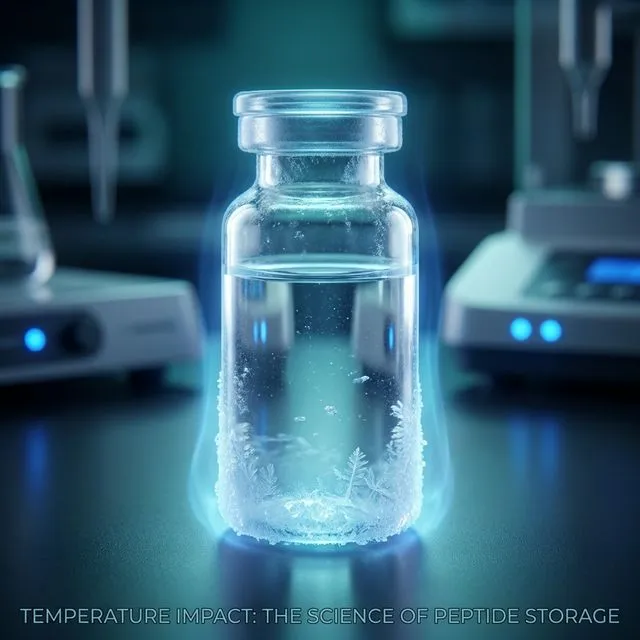
“Keep it in the fridge” sounds like a simple rule, but the reason it matters is not arbitrary. Temperature changes alter reaction speed, and in peptide workflows that can change degradation pressure faster than people expect.
The broad framework behind that rule is the Arrhenius equation, or more practically, the rule-of-thumb modeling that grows out of it.
The chemistry behind the rule of thumb
The Arrhenius equation describes how reaction speed changes with temperature. The exact math is more detailed than most users need, but the practical rule of thumb for many organic systems is simpler:
For every 10°C (18°F) rise in temperature, the rate of degradation roughly doubles (Q10 ≈ 2 rule). This is an established pharmaceutical stability principle. (Waterman & Adami, Int J Pharm 2005 — PMID 15778049 | ICH Q1A(R2))
What that means in a familiar storage example
Compare a standard refrigerator with ordinary room temperature:
- Refrigerator: ~4°C (39°F)
- Room Temperature: ~24°C (75°F)
- Difference: 20°C
Applying the rule (doubling twice):
- 4°C → 14°C = 2x faster degradation
- 14°C → 24°C = 2x faster again (4x total)
That gives a ~4x baseline estimate for a 20°C increase under a simple Q10 model. The important word there is baseline. Real peptide-specific behavior can deviate because aggregation and formulation effects do not always follow a clean Arrhenius pattern. The rule is still useful, but it should not be mistaken for a universal exact multiplier.
Why the same temperature shift does not mean the same risk for every peptide
The same temperature logic applies broadly, but the baseline stability still varies from one peptide family to another. That means the same exposure event can be more consequential in one workflow than in another.
Semaglutide and liraglutide sit in the stronger stability group inside the current repo evidence, especially when the discussion stays close to approved-product labeling. That does not make room-temperature exposure irrelevant, but it does mean their handling story is better supported than it is for many other peptides. Tirzepatide, BPC-157, HGH, and tesamorelin still require stricter cold-storage discipline in practical planning because temperature stress can compound more quickly once the formulation and handling context become less forgiving.
Practical scenarios people actually worry about
If a vial was left out overnight, treat it as an exposure event rather than an automatic failure or an automatic non-event. The penalty is still peptide-specific and often model-based unless direct assay data exists. A hot mailbox is higher risk because temperatures above ordinary room temperature can increase both degradation pressure and aggregation risk. A week of travel is different again, because repeated time away from refrigeration can consume a meaningful fraction of a usable storage window. In all three cases, the safer pattern is to document the event, return the vial to proper storage if appropriate, and reassess with the calculator plus visual inspection rather than jumping to confident conclusions.
Summary
Temperature control remains one of the highest-value habits in peptide handling because it reduces degradation pressure without adding much complexity. Refrigeration is still the preferred range, room temperature is a higher-stress state rather than a neutral one, and hotter environments deserve extra caution. The useful takeaway is not fear. It is that temperature events should be tracked and interpreted proportionally rather than ignored or dramatized.
References & Evidence
-
ICH Q1A(R2): Stability Testing of New Drug Substances and Products. EMA | FDA — The regulatory framework establishing temperature stress testing in 10°C increments.
-
Waterman KC, Adami RC. “Accelerated aging: prediction of chemical stability of pharmaceuticals.” Int J Pharm. 2005. PMID 15778049 — Foundational paper on Arrhenius-based accelerated pharmaceutical stability modeling.
-
Wang W, Roberts CJ. “Non-Arrhenius Protein Aggregation.” AAPS J. 2013. PMID 23615748 — Demonstrates that protein aggregation does not always follow simple Arrhenius behavior, providing important context for the 5–10x estimate as a range rather than a fixed ratio.
-
PeptideClock decay rates: [Model Estimate — PeptideClock]. Peptide-specific daily decay rates in
src/data/peptides.tsare model estimates calibrated from available pharmacological data and general peptide stability principles — not direct experimental assay data except where noted (Semaglutide, Liraglutide: high confidence from labeled pharmaceutical stability).