How Long Does BPC-157 Last? Shelf Life & Stability Guide
How long does reconstituted BPC-157 last? This guide separates documented gastric-stability evidence from conservative storage estimates for opened vials.
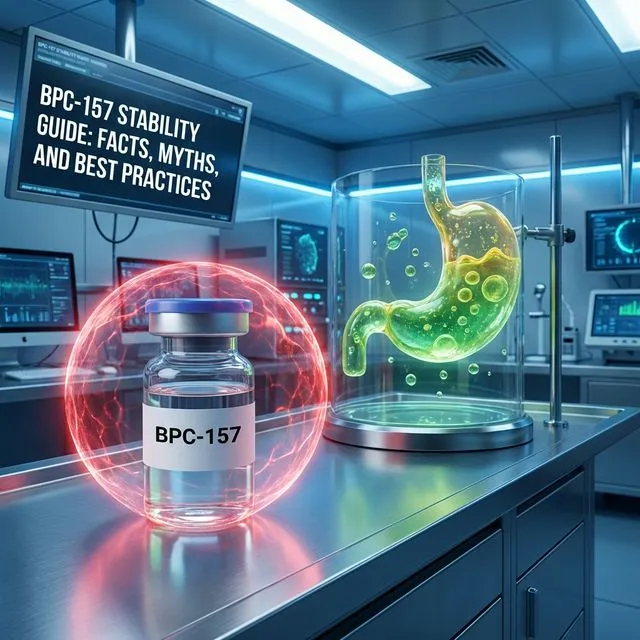
BPC-157 (Body Protection Compound-157) is often described as one of the more chemically tolerant peptides in research discussions, largely because published literature documents unusual stability in gastric conditions.
That does not mean you can store it indefinitely at room temperature or assume freezing is harmless after reconstitution.
The useful question is not whether BPC-157 sounds “tough.” The useful question is what the existing literature actually supports and where the storage story is still an extrapolation.
Why BPC-157 gets treated differently
Most peptides are discussed as fragile solution-phase compounds. BPC-157 is treated differently because the literature describes it as a stable gastric pentadecapeptide, which is a meaningful signal that its chemistry may be more resilient than many readers expect.
The gastric-stability finding matters because human gastric juice is normally destructive to standard peptides. Published work describing BPC-157 persistence in that setting is relevant evidence for chemical robustness. But it is still important to stop where the evidence stops. Gastric stability is not the same thing as a direct shelf-life assay for a reconstituted vial stored in the refrigerator and accessed repeatedly over time. That is why storage windows for reconstituted BPC-157 remain conservative extrapolations rather than label-backed facts.
Powder storage and liquid storage are still different problems
Before reconstitution, lyophilized BPC-157 is usually treated as the more stable storage form. Short transit exposure at room temperature is generally lower risk for the powder than for the liquid, but that does not mean the exact shipping-loss profile has been formally established in direct BPC-157 assay data. The cautious default is still to move the powder into freezer storage until it is needed.
What the conservative liquid-storage view looks like
Once BAC water is added, the clock starts in a way that powder storage never had to confront. BPC-157 may be more chemically resilient than many peptides, but the liquid state still introduces temperature, contamination, and handling variables that the gastric literature does not directly settle.
That is why the site treats 28 to 35 days as a conservative protocol default for standard refrigerated use when maximum confidence matters, while still acknowledging that the calculator may model meaningful residual potency beyond that point. The distinction is important: a clear vial can still be chemically older than it looks, and a modeled potency percentage is not the same thing as direct physicochemical shelf-life data.
Short accidental room-temperature exposure may be less alarming here than it would be for a more fragile peptide, but it is still not backed by a direct study proving a specific safe 24- or 48-hour reconstituted room-temperature window. Freezing reconstituted liquid remains the wrong answer for the same broader reasons it is the wrong answer elsewhere: ice formation, concentration shifts, and unnecessary structural stress. Powder and liquid do not share the same freeze logic.
The myths worth dropping
BPC-157 does not “die instantly” under ordinary indoor light, but that should not be confused with permission to store it carelessly. A cloudy vial should never be rescued by shaking. And saline is still not equivalent to BAC water for a multi-dose workflow simply because both are liquids. BAC water remains the more conservative repeated-access choice because of its preservative support, even though preservative support is not the same thing as a sterility guarantee.
Summary: The Protocol
To get the most out of your BPC-157:
- Store Powder in Freezer until needed.
- Reconstitute with BAC Water (standard 2ml or 3ml).
- Keep Refrigerated (2-8°C) at all times after mixing.
- Use within a conservative research window and track the vial with the calculator rather than assuming gastric-stability evidence proves a specific reconstituted shelf life.
- Discard if visual clarity changes.
By following these rules, you reduce avoidable handling risk and rely on conservative model estimates rather than unsupported certainty.
References & Evidence
-
Sikiric P, et al. “Stable gastric pentadecapeptide BPC 157: novel therapy in gastrointestinal tract.” Curr Pharm Des. 2011;17(16):1612-32. PMID 21548867 — Documents BPC-157 stability in human gastric juice for >24 hours and its GI therapeutic applications.
-
Sikiric P, et al. “Toxicity by NSAIDs. Counteraction by stable gastric pentadecapeptide BPC 157.” Curr Pharm Des. 2013;19(1):76-83. PMID 22950504 — Documents BPC-157 cytoprotection and chemical stability.
-
Sikiric P, et al. “Stable gastric pentadecapeptide BPC 157 in trials for inflammatory bowel disease (PL 14736). Full and distended stomach, and vascular response.” Curr Pharm Des. 2007;13(1):91-111. PMID 17186181 — IBD trial data and gastric stability evidence.
-
Chang CH, et al. “The promoting effect of pentadecapeptide BPC 157 on tendon healing involves tendon outgrowth, cell survival, and cell migration.” J Appl Physiol. 2011;110(3):774-80. PMID 21030672 — Tendon healing mechanism.
-
Sikiric P, et al. “Stable Gastric Pentadecapeptide BPC 157 and Wound Healing.” Front Pharmacol. 2021;12:627533. PMID 34267654 — Comprehensive wound healing review.
-
ICH Q1A(R2): Stability Testing of New Drug Substances and Products. EMA Guideline — Framework for stability class assignments.
Confidence Note: BPC-157 stability data referenced above comes from pharmacological and gastric-stability literature, not a direct reconstituted shelf-life assay. Storage windows in this article are conservative extrapolations based on BPC-157’s documented chemical robustness and general peptide stability principles (ICH Q1A(R2)).